

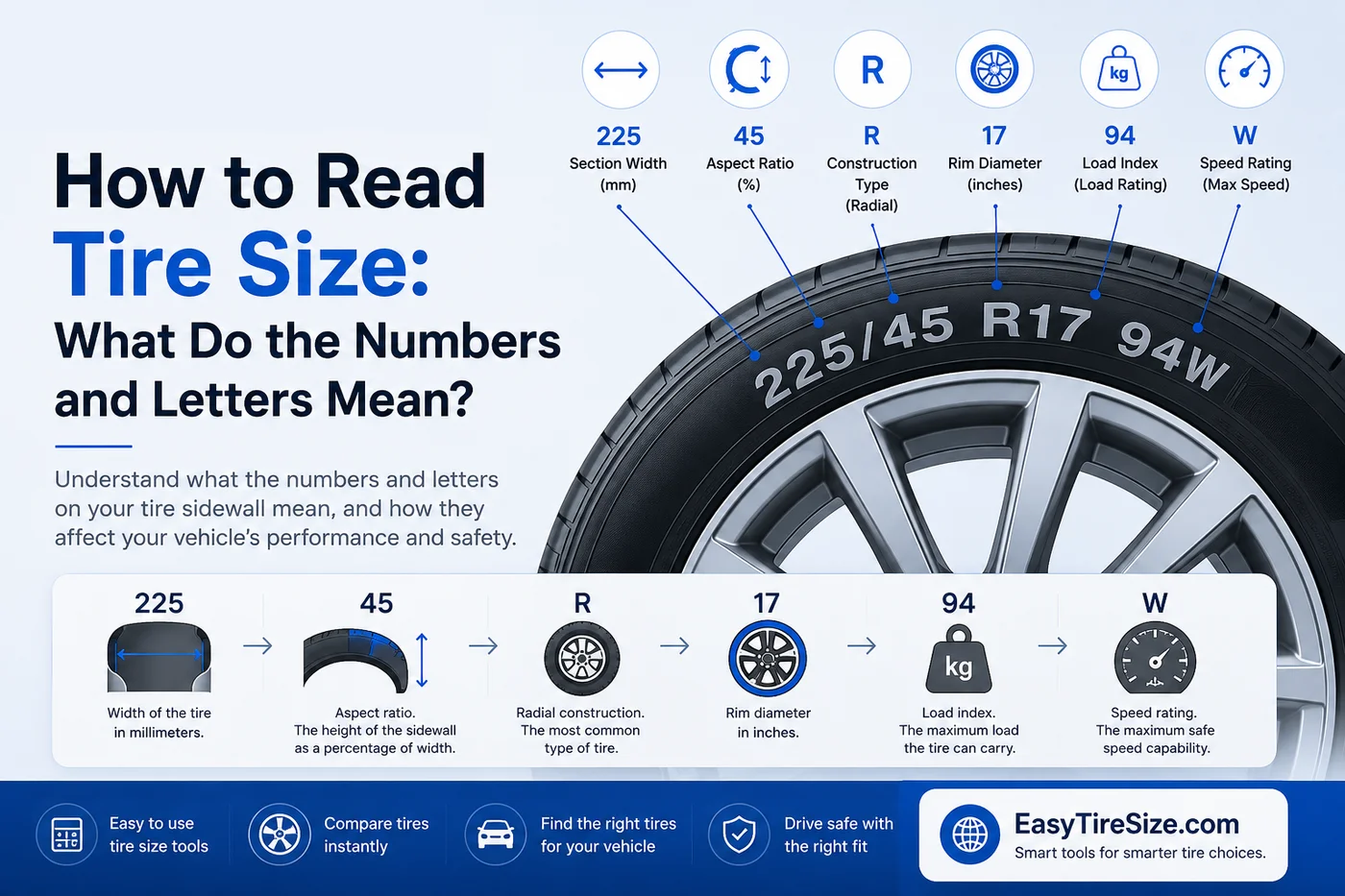
A car tire’s sidewall is stamped with several codes — not just random numbers, but important information about the tire’s size, construction, load capacity, and top speed rating. Understanding what they mean helps you choose a tire that’s correct, safe, and suited to how you drive.
Example: 225/45 R17 94W
Here’s what each part of the code means:
| Code | Meaning | Description |
|---|---|---|
| 225 | Tire Width | The first 3 digits — the tire's tread width, in millimeters. |
| 45 | Aspect Ratio | The next 2 digits — sidewall height as a percentage of width (taller sidewall = softer ride, lower sidewall = sportier handling). |
| R | Construction | R = Radial, the standard construction for passenger cars. |
| 17 | Rim Diameter | The wheel diameter this tire fits, in inches. |
| 94 | Load Index | A reference number for the max weight a single tire can carry (94 ≈ 670 kg). |
| W | Speed Rating | A letter for the tire's maximum safe speed (W ≈ 270 km/h). |
A letter before the size also matters: P means P-Metric (passenger car), LT means Light Truck (for pickups and heavier loads). No prefix means a Metric/Euro-Metric size.
Other sidewall markings worth knowing
Beyond the size code, the sidewall carries information that helps you buy and use tires safely:
- DOT and Tire Identification Number (TIN) — required by the U.S. Department of Transportation; the last four digits give the week and year of manufacture, used to check a tire’s age and recalls.
- UTQG — three grades, Treadwear, Traction, and Temperature, tested under methods set by the U.S. NHTSA so you can compare tires on tread life, wet grip, and heat resistance.
- M+S or the 3PMSF symbol (three-peak mountain snowflake) — indicates mud/snow capability, which isn’t needed in Thailand’s climate.
Safety tip: the Load Index and Speed Rating of a replacement tire should always be equal to or higher than the specification listed in your owner’s manual or on the tire placard on the driver’s door jamb.
Why does getting the size right matter?
Fitting the wrong tire size can affect:
- Speedometer accuracy — a different overall diameter throws off the speedometer reading, and the error roughly tracks the percentage change in diameter.
- Ground clearance — a tire that’s too large or too small can rub against the fender or suspension.
- Handling and grip — width and construction directly affect how the car grips the road.
Tire makers generally advise keeping a replacement tire’s overall diameter within ±3% of the original. Before replacing your tires, always check the size stamped on the sidewall, or use a tire size calculator to compare a new size against your current one before deciding.
References
- NHTSA – Tires (TireWise) — U.S. National Highway Traffic Safety Administration
- Tire Industry Association – Reading a Tire Sidewall
- BFGoodrich – How to Read a Tire Sidewall