

Calculate and compare
tire and wheel sizes
A complete toolkit for tires and wheels. Easy to use, 100% accurate results.
- Calculate tire and wheel size
- Compare speedometer accuracy
- Get safety recommendations
- Every tool, in one place


Popular tools
Tire Size Calculator
Calculate and compare tire sizes
Plus / Minus Sizing
Find a matching size for a new wheel diameter
Wheel Fitment
Calculate offset and wheel position
Unit & Tire Converter
Convert units and tire sizes
Comparison & Reports
Compare multiple sizes and generate a report
Speedometer Error
Calculate speed reading deviation
Popular tire sizes
The sizes cars sold in Thailand leave the factory on most. Open one for its height, the cars that use it and the sizes that can replace it.
Recommended articles
View all articles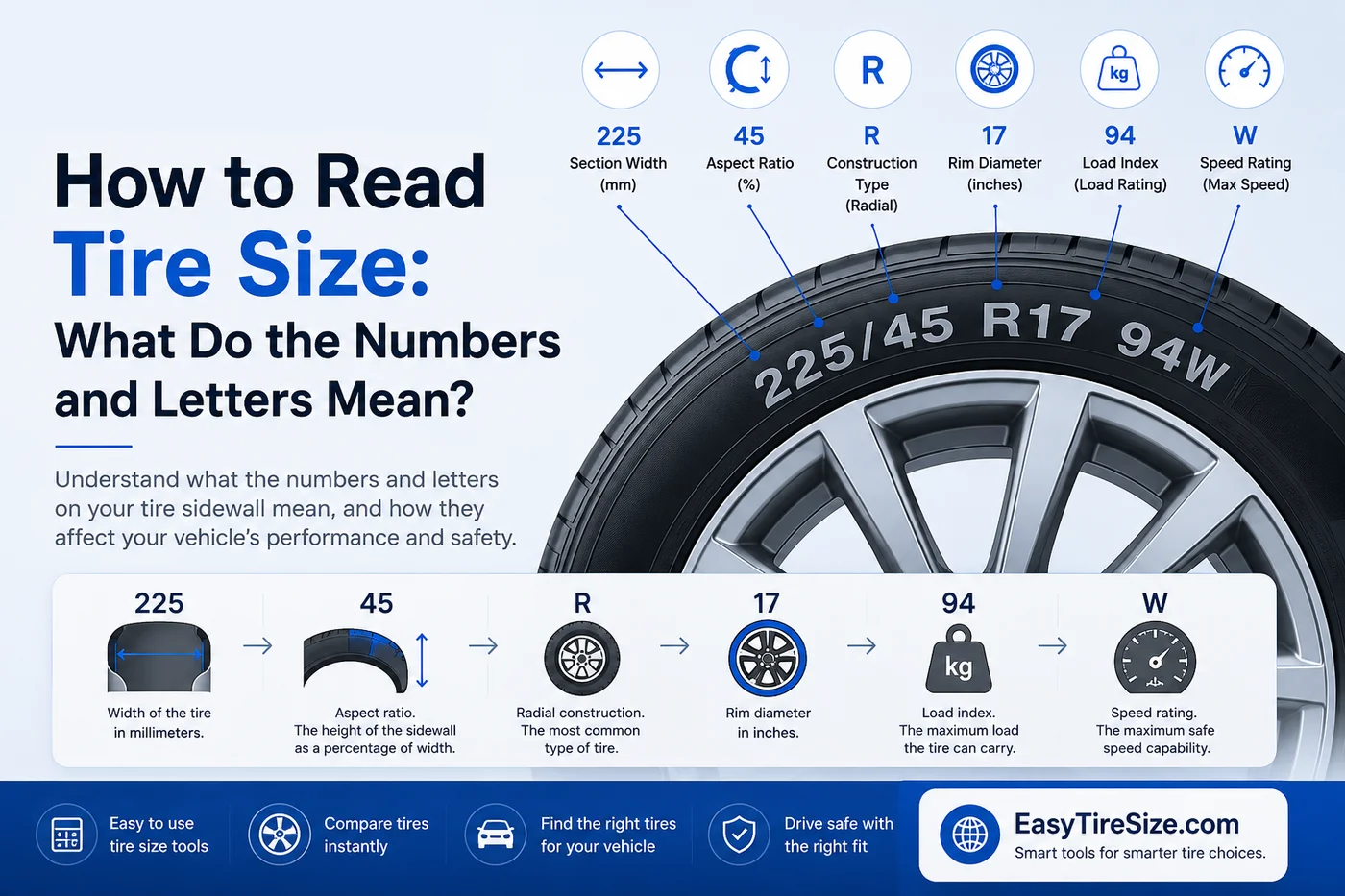
Recent calculations
- No calculations yet — try a tool above.
Accurate & reliable
Formulas based on international standards
Easy to use
No complexity — results in seconds
Private
We don't store your personal data
Works everywhere
Mobile, tablet, and desktop supported
Tire Size Calculator and Comparison Chart, Online
EasyTireSize is a tire size calculator that runs in your browser: nothing to install, no account, no usage limit. Type the numbers off the sidewall, say 225/45 R17, and you get sidewall height, overall diameter, circumference and revolutions per kilometer, all calculated from your size rather than looked up on a printed chart. The same pages are available in Thai and English.
Reading 225/45 R17 in millimeters
Read it literally: 225 mm of tread width, an aspect ratio of 45 so the sidewall stands 45% of that width, and a 17 inch rim. The sidewall works out at 225 x 0.45 = 101.25 mm, the rim converts with 17 x 25.4 = 431.8 mm, and adding a sidewall at the top and the bottom gives an overall diameter of 431.8 + (101.25 x 2) = 634.3 mm. Two tires can share a tread width and still stand at different heights, which is why diameter always starts from the sidewall. Circumference is simply pi (3.1416) x overall diameter, about 1,992 mm per turn, and dividing one kilometer by that gives roughly 502 revolutions per kilometer.
Two sizes side by side, read as a percentage
A comparison sets your current size beside the one you are considering and lists the difference in tread width, sidewall height, circumference, revolutions per kilometer and ride height, with overall diameter given in both millimeters and percent. Speedometer error is that same percentage, because a car counts speed from how fast the wheel turns rather than measuring the road. The thresholds work off the diameter difference: within plus or minus 3% is safe, 3-5% deserves caution, and more than 5% either way is risky. So the answer is never just yes or no, it is how far the new size sits from stock.
A speedometer table from 20 to 140 km/h
The Speedometer Error tool does not hand back a single number. It lays out a table stepping through 20, 40, 60, 80, 100, 120 and 140 km/h, putting the indicated reading next to the actual speed. A table matters because the error is a fixed proportion: a tire 2% larger keeps true speed 2% above the dial at every step, yet the gap in km/h keeps growing. At 40 it is under 1 km/h, at an indicated 100 you are really doing 102, and by 140 it is close to 3 km/h.
Rim sizing and wheel offset (ET)
The wheel tools split the job cleanly. Plus / Minus Sizing is for moving a 17 inch rim to 18, listing the sizes that hold overall diameter closest to stock by trading rim diameter against sidewall height. Wheel Fitment takes the offset (ET) and width of both the old and the new wheel, then reports how much further the rim edge pokes outward, how much the inner clearance toward the strut changes, how much the track width changes, and what the backspacing of the new wheel comes to. The first three are differences against your current wheel, not a verdict on whether it will rub, so treat them as figures to check against the car.
Units, multi-size tables and motorcycle fitments
The converter swaps millimeters and inches, millimeters and centimeters, and pressure across psi, bar and kPa, which is what you want when comparing tire sizes in inches against metric numbers. With several candidates in hand, the comparison page lines every size up in one table and turns it into a report you can keep. The inputs accept 100-400 mm tread widths, 20-100% aspect ratios and 10-30 inch rims, so a motorcycle size such as 120/70 R17 is covered as well, not only cars, pickups and SUVs. Every tool works on a phone, a tablet or a desktop.
Wider tread, shorter sidewall: what changes
The numbers here are geometry; what a driver feels is another matter. A tread 10 to 20 mm wider does not enlarge the contact patch, it only reshapes it, wider and shorter. Dry cornering grip improves and braking distances shorten slightly, and you pay for it elsewhere: a heavier tire, more rolling resistance, worse fuel economy, heavier steering when parked, and more noise in the cabin. Wide tires also follow ruts more readily, and if the tread cannot clear water, the extra width gains nothing in the rain. A short sidewall works differently. There is less flex, so the steering feels sharper. But the sidewall is the last cushion before the rim, and every millimeter removed is comfort gone. Over a bridge joint or a pothole the hit reaches the suspension directly; a single hole can blister a sidewall or bend a rim, and at a curb there is less rubber guarding the wheel. The tire size calculator shows both sidewall heights in millimeters, so you can see exactly how much disappears. Whether that is bearable depends on your daily roads, and on you.
Three sizes around 205/55 R16
Take a common sedan size, 205/55 R16: 631.9 mm overall diameter on a 112.75 mm sidewall. Step up to a 17 inch rim with 215/45 R17 and you get 625.3 mm, 6.6 mm smaller, or -1.04%, with the sidewall down to 96.75 mm. A smaller tire turns more often, so the needle reads high: an indicated 100 is really about 99 km/h. Ride height drops 3.3 mm, half the diameter gap. Push the rim two inches up instead, to 225/40 R18, and you get 637.2 mm, 5.3 mm bigger, or +0.84%. Now the needle reads low, showing 100 while you are doing about 101. That is the direction to watch, because the error hides your real speed. The sidewall falls to 90 mm, nearly 23 mm gone, which is the price of those two inches of rim. Now look the other way, at 195/65 R15: 634.5 mm on a tall 126.75 mm sidewall. A car delivered on that size and moved to 205/55 R16 loses 2.6 mm, or -0.41%. All three stay inside the plus or minus 3% band, yet 195/65 R15, the closest match on paper, carries the tallest sidewall, while 225/40 R18 at just +0.84% carries the shortest. Equal percentages do not mean equal feel. If the wheels have been changed before, start again from the factory size, or the old error stacks onto this one.
What you must check on the car itself
The Load Index and Speed Rating that follow the size, 91V for instance, are not checked here. What matters is that the new tire is not below the figure in your owner's manual or on the tire placard on the driver's door jamb; matching whatever is fitted right now is not the test, because that tire may have been under spec all along. Pressure is similar: the converter turns psi into bar or kPa, but it cannot say what this car should run, and the number molded on the sidewall is a maximum the tire can hold, not a setting. Each tread width also has an approved range of wheel widths. Too wide on a narrow rim bulges the sidewall and dulls the response; too narrow on a wide rim leaves the shoulders never fully loaded. The wheel fitment page takes wheel width only to work out shift and track change, not to judge whether tire and rim suit each other. Clearance is another blind spot: the site knows neither your model nor your suspension, so turn the wheel lock to lock, load the car until the suspension settles, and look with your own eyes. Finally, one size from two brands can measure several millimeters apart, because molds and casings differ. The math starts from the numbers printed on the sidewall, so that gap is invisible here, and there is no brand, price, or stock database behind it.
A reading order before you decide
With several sizes in mind, a reading order saves time. Take the diameter percentage first and drop whatever sits too far off, then look at the sidewall height change, which is what decides comfort, then read the speedometer table at the speeds you actually drive rather than the last row. A size that passes on paper is shortlisted, not cleared. People also forget that if you are not buying four, both tires on an axle should share size and tread pattern, and on all-wheel drive all four diameters need to stay close, because mismatched rotation loads the driveline. Once you have decided, keep the final numbers: overall diameter, revolutions per kilometer, and the percentage away from the factory size. Next time you compare the speedometer against GPS, or shop for tires again, you will not be starting over. Whatever is left belongs with a mechanic who can see the car.
At the tire shop, just open this page on your phone. Pick a tool from the menu above, enter the size fitted to your car alongside the one you are weighing up, and read the differences before you commit. Everything is worked out from standard tire geometry, and actual dimensions vary a little between brands, so use these numbers to prepare the conversation with your fitter and check them against your vehicle handbook.